

Delving into the dynamic world of call centers, this comprehensive guide is designed to enlighten anyone interested in the intricate workings of these crucial customer communication hubs. From business owners considering call center services to curious individuals and potential employees, this guide aims to provide valuable insights in an engaging, straightforward manner.
Imagine a bustling hub where every phone call brings a new challenge or opportunity. This is the everyday reality of call centers, the backbone of customer service in countless industries. Here, we’ll uncover the layers of a call center’s function, its importance in business strategy, and how it adapts to various business needs.
In this content
What is a Call Center for?
A call center is a centralized department within a company or an outsourced facility designed for handling customer communications, primarily through phone calls. It serves as a critical link between a business and its customers, ensuring that each call is an opportunity to strengthen this connection.
Here’s a more precise definition of what a Call Center is:
A call center is a facility that handles a high volume of phone calls for tasks like customer service, sales, or support. These centers are staffed with trained agents who manage interactions with customers or clients, aiming to provide assistance, resolve issues, gather information, or promote products or services
What is a Call Center for?
The primary role of a call center is to manage customer interactions on a large scale. This includes:
- Resolving customer complaints and queries.
- Providing technical support and assistance.
- Conducting telemarketing and sales calls.
- Carrying out customer satisfaction surveys.
- Handling emergency response and support.
However, Call Centers aren’t limited to customers.
At its core, a call center is the vital communication channel between companies and clients or employees. It stands as the centralized hub for efficiently managing a substantial volume of inbound and outbound telephone communications. Functioning as the communication nucleus of a business, it plays a crucial role in ensuring seamless and responsive engagement with clients and employees
Understanding the nuances of call centers reveals that they are more than mere facilitators of phone calls. These hubs actively shape customer experiences, functioning as adept problem solvers, reliable information providers, and crucial frontline representatives. Whether it’s addressing inquiries or resolving issues, call centers play a pivotal role in crafting positive interactions.
What does a Call Center do?
A call center, at its essence, is a dynamic entity that actively shapes customer experiences. It functions as:
Problem Solvers: Call centers are equipped to address and resolve customer issues efficiently, contributing to heightened satisfaction and loyalty.
Information Providers: They serve as reliable sources of information for customers, ensuring that inquiries are met with accurate and valuable responses.
Relationship Builders: Acting as the frontline representatives of a business, call centers play a crucial role in fostering positive relationships with clients and customers.
Call center agents are the frontline warriors in customer service. They are trained to manage a wide array of customer interactions, from troubleshooting product issues to advising on service options. Their ability to handle calls efficiently and empathetically directly impacts customer satisfaction and loyalty.
How do Call Centers work?
A call center operates as an extension of a business, acting as a bridge between the company and its clients or employees. It’s not merely a facility handling calls but a dynamic entity that actively contributes to customer satisfaction and brand reputation. By managing communication effectively, call centers ensure that businesses remain accessible, responsive, and capable of addressing customer needs promptly.
Call centers operate through a blend of skilled human resources and advanced technology. Calls are typically directed via an Interactive Voice Response (IVR) system and then routed to the appropriate agent. Sophisticated software tracks performance metrics and manages call queues, ensuring efficiency and quality in customer interactions.
Types of Call Centers
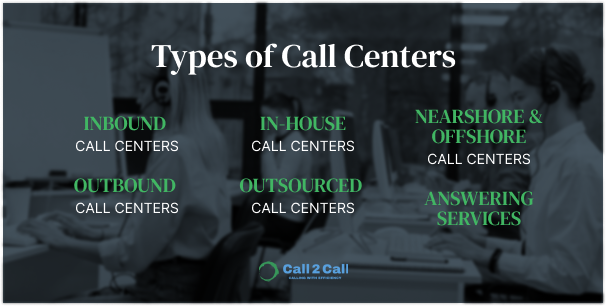
Diverse types of call centers cater to specific business requirements, each contributing distinctly to business dynamics:
Inbound Call Centers
Focus on managing incoming customer calls. Agents address queries, offer support, and provide information.
They act as the first line of support, addressing customer inquiries, and ensuring swift issue resolution, thus fostering a positive customer experience right from the moment the call is received.
Outbound Call Centers
Outbound call centers take a proactive stance, strategically initiating calls for for telemarketing, lead generation, or customer feedback. This approach positions them as pioneers in driving business initiatives and expanding market reach.
In-house Call Centers
Some businesses opt to have in-house call centers, where the facility is owned and operated by the company itself. This provides more direct control over operations and customer interactions.
Outsource/BPO Call Centers
Outsourced or BPO are external companies that handle call center operations, offering flexibility and cost savings. This includes tasks such as recruitment, onboarding, quality assurance, management and human resources.
Nearshore & Offshore Call Centers
Positioned in geographically convenient locations, these centers balance cost and cultural alignment for global businesses. This call centers can be in close proximity (nearshore) or in different countries (offshore) to optimize costs and tap into global talent pools.
Answering Services
Focused on basic customer interactions like taking messages or routing calls.
Answering services operate more as silent partners, handling calls on behalf of clients. They project professionalism and reliability, ensuring a polished image in customer interactions.
4 signs that your business needs a Call Center
- Increasing Call Volume: Struggling to handle the growing number of customer calls.
- International Expansion: Needing to support customers across various time zones and languages.
- Specialized Customer Support Needs: Requiring expertise in handling specific types of customer queries or technical support.
- Desire for Enhanced Customer Experience: Aiming to provide a consistently high level of customer service.
How to determine your Call Center staffing needs
To effectively determine staffing needs, businesses should analyze historical call data, predict future call volumes, and consider factors like average handle time, peak calling hours, and the complexity of calls. This will help in creating a balanced schedule that ensures adequate coverage without unnecessary staffing overheads.
Advantages of working with Call Center
- Improved Customer Service: Providing professional and consistent support around the clock.
- Cost Efficiency: Reducing the need for in-house infrastructure and staffing.
- Focus on Core Competencies: Allowing businesses to concentrate on their primary goals and growth.
- Scalability and Flexibility: Easily adjusting to fluctuating call volumes and business growth.

Disdvantages of working with Call Centers
- Quality Control Issues: Variability in service quality, especially with outsourced centers.
- Cultural and Linguistic Hurdles: Offshore centers might struggle with language nuances and cultural understanding.
- Dependency Risks: Reliance on external service providers can lead to vulnerabilities if issues arise.
Conclusion
Call centers are not just communication channels; they are strategic assets that can significantly impact customer satisfaction and business success. Whether you’re looking to integrate a call center into your business model, seeking a career in this vibrant field, or simply exploring the concept, understanding the multifaceted nature of call centers is essential. They are the bridges of communication, ensuring every customer interaction is an opportunity to build stronger relationships and drive business forward.